


Every Tuesday, we take one risk event from somewhere in the world and classify it according to the Five Quadrants methodology.
Quadrant 4
Elias Canetti, in his 1960 book Crowds and Power, tells us why a crowd breaks glass and destroys property. He argues that the loud, sudden sound of shattering glass acts as a “collective discharge,” a noisy celebration of the crowd discovering its own strength. Smashing shop fronts, bus shelters, and statues symbolises the rejection of physical and social boundaries. The motivation is fundamentally different from premeditated theft.
“The noise of destruction adds to its satisfaction; the banging of windows and the crashing of glass are the robust sounds of fresh life.” … “The more usual kind of destruction … is simply an attack on all boundaries.”
Unlike a common thief who understands the value of an object and wishes to steal it for personal gain, a destructive crowd smashes glass to destroy the very concept of private property. By destroying physical boundaries, they create common space. The secondary market, however, is a different story.
I board a plane to Paris in several hours and may stumble upon some nearly new sidewalk secondary markets where I understand Dior, Kenzo, Celine, and Burberry products are selling well. Locating a Hermes scarf is less likely. While their Paris store on avenue George V had its windows smashed, the major looting took place in its Marseille location.
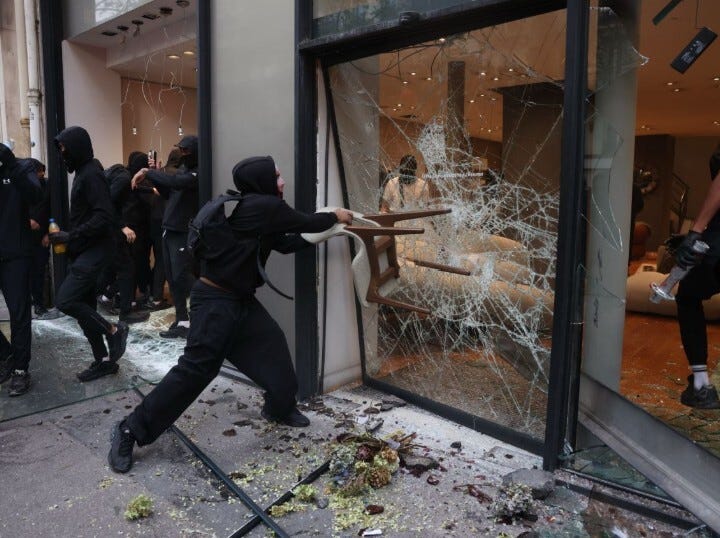
Figure 1: Breaking glass. This image is by photographer Lucy North and is shared from her LinkedIn page. linkedin.com/in/lucy-north-b0a455232.
The Ratio of Revolution
The root cause of a revolution is often structural and simple. Scolding teenage looters for rampaging (essentially taking their underdeveloped prefrontal cortices out for a “rager”) is counterproductive.
Gustave Le Bon, author of The Crowd: A Study of the Popular Mind (1895), believed that a “collective mind” takes over in a crowd. And it’s not a bright one. Le Bon argued that crowds cannot accumulate intelligence; they can only accumulate mediocrity. (I often borrow that insight when criticising today’s LLM-composed text). In a crowd, the intellectual traits of an educated person vanish, leaving only baseline primal instincts. He adds that crowds are incapable of rational thought, logic, or critical reflection. They can accept or reject ideas as a whole but can’t tolerate discussion or contradiction. The members of a crowd are highly suggestible, easily hypnotised, and entirely driven by unconscious, emotional impulses.¹
Le Bon helps explain how crowds behave once formed. Demographics may help explain why the conditions for their formation arise in the first place.
In 2011, Claudia and I wrote an INSEAD working paper titled Demographics: The Ratio of Revolution. We argued that political instability and anti-government revolutionary potential do not happen in a vacuum but erupt when two specific demographic phenomena meet a sudden economic shock.
A youth (15- to 29-year-old) bulge that has increased by at least 50% in 15 years, and
A ratio of youth to the “job-maker” class (30 to 44-year-olds) of greater than 1.3.
Those two events often lead to unemployment and inflation at precisely the time a large cohort of youth try to find jobs and partners, pay off education debt, and start families. Youth revolutions with these exact two metrics occurred in Japan in 1968, the US in 1974, China in 1989, Egypt in 2011, and, as we somewhat prophetically stated in the paper, the banlieues of Paris forever.
Speaking of those from the banlieues, we said that “due to their poor cultural assimilation—one could argue this is largely due to France’s strong cultural and geographic boundaries—they tend not to be considered on an equal basis for employment or education opportunities and thus remain a highly unemployed, disenfranchised and thus combustible group.”
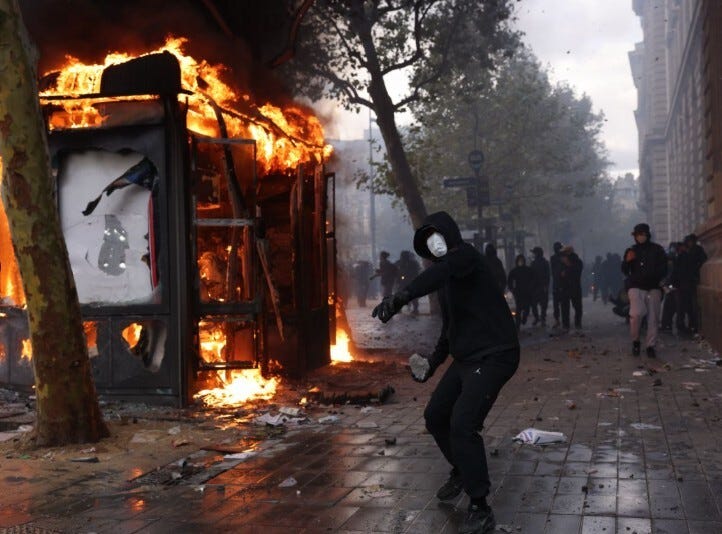
Figure 2: Heated bus shelters. Photo thanks to Lucy North.
This Crowd Is Different
It makes perfect sense for job and partner seekers in their 20s to vent frustrations. Less obvious is the incentive for 12- to 18-year-old teenage² riots. They live at home, go to secondary school, and doom scroll. The French Justice Ministry reports that nearly 8,000 individuals have been taken into police custody since the unrest began. About 85% were minors under 18. Many were as young as 12. Most of the 2005 rioters were 18 or older, and during the 2023 unrest, 70% of those detained were legal adults. What drove these teenagers into the streets? They are too young to face many of the employment, housing, and family pressures central to our demographic model of revolution.
Schools, initially
No regular teachers, rats, broken toilets, leaking roofs, crumbling walls, mould, exposed electric cables. The initial grievances (the catalysts) are easy to understand. Less obvious is how complaints about school conditions escalated into widespread unrest. Social media probably did most of the work, accelerating the spread of frustration and encouraging the teenagers to join crowds. External parties, perhaps attempting to engineer a shift in political sentiment to the right, may also have had a hand. We’ll never know for sure.
Prof Galloway has a theory that an excessive social media focus leads to youth loneliness. Jonathan Haidt’s contention is that smartphones and a shift from a play-based to a phone-based childhood has led to a teenage mental health crisis. Both make intuitive sense. Their hypotheses raise the probability that the youthfulness of the French riots (European-wide, really, but we need to focus) may be the result of lonely, high-screen-time teens finding an outlet.
A moderate amount of volatility helps prevent extreme highs and lows. Low volatility is an indication of blissful ignorance, while high volatility implies information overload and fear. Might the teen riots be the consequence of too much inactive and involatile screen time?
French Teen Demographics
France has over 10,000 public and private secondary schools. With somewhat dodgy federal finances due to the government’s relinquishing of its sovereign currency, the franc, and its propensity to poorly allocate resources, school maintenance and teacher salaries (and thus quality and quantity) have suffered. The secondary student population size has been constant for sixty years. That is about to change dramatically.
Over the next twelve years, this demographic is forecast to fall by 21%. Does that mean France will need 2,000 fewer secondary schools? Possibly, though the adjustment will hardly be uniform. Falling enrolment will leave some schools underutilised, placing additional pressure on maintenance, budgets, and staffing. Teachers may leave the profession, schools may consolidate, and buildings could deteriorate further. France faces the peculiar challenge of improving educational opportunities while its school-age population contracts.
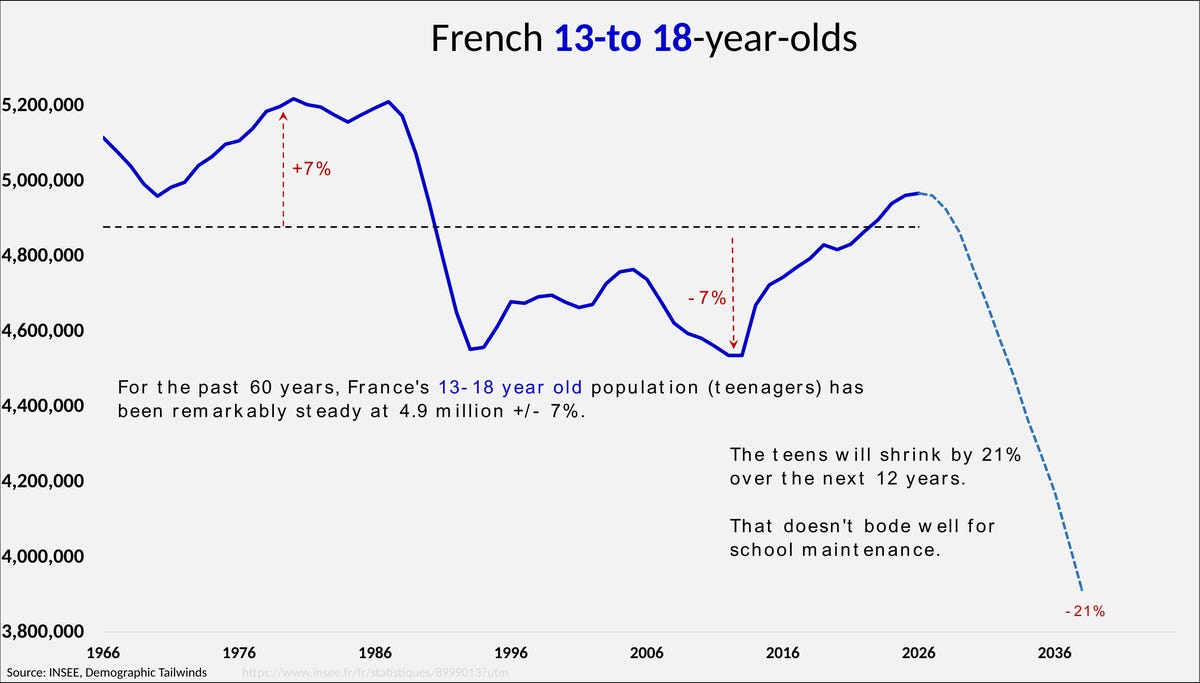
Figure 3: French 13- to 18-year-olds, 1966 to 2038. Source: INSEE, Demographic Tailwinds.
What Risk Quadrant Do Youth Riots Inhabit?
Crowd behaviour belongs in Quadrant 4, as do most complex social phenomena. Individuals influence one another, small provocations can trigger disproportionate responses, and unrest can spread rapidly through networks that are difficult to observe or predict. We can anticipate broken windows and looting, but forecasting when, where, and how far the unrest will spread is another matter.
The solution starts with making education and opportunity accessible for all and federal spending with an objective to reduce economic gaps. Not socialist redistribution per se, but engineering smart incentives to achieve broad-based success. That takes time.
Until then, Italian Prime Minister Giorgia Meloni’s plan makes sense: Those who break things pay, and if the breakers are minors, their parents pay. Preventative detention extended from adults to minors, more magistrates, more detention centres, more police and, for a while, more military personnel. Occasionally, a firm response from an adult is the best solution when teens morph into destructive crowds.
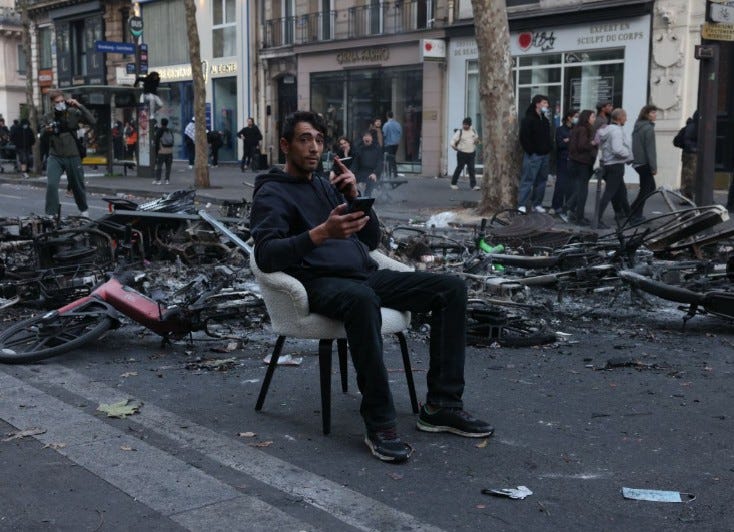
Figure 4: Where’s the espresso? This image reminds me of John Oliver’s impersonation of a Frenchman. Photo courtesy of Lucy North.
Now I Need You
This project only works if we have a real conversation. If you have teenage children in French secondary schools, please volunteer some inside information. From where did the call to unite and riot emerge? If you’re a teenage rioter, can you suggest where I might find some discounted luxury swag?
¹ James Surowiecki argues in his book, The Wisdom of Crowds, that the many are smarter than the few and that the aggregation of information in groups often results in better decisions. His unfortunate mistake was referring to a large selection of unconnected and independently minded individuals as a “crowd” instead of a “large independent sample.” A better title might have been “The Wisdom of a Large Set of Independent and Informed Opinions.”
² Kids mature faster than they once did. 12 is the new 13.
David Munro